

If you liked reading this, feel free to click the ❤️ button on this post so more people can discover it on Substack 🙏
Welcome!
For those new here, Hedge Mystic is a reader-supported publication where I explore spiritual topics alongside seasonal wisdom and creative practice.
All of my articles are free to read, but you can make a one-time donation if you appreciate my work or upgrade your subscription to show your support.
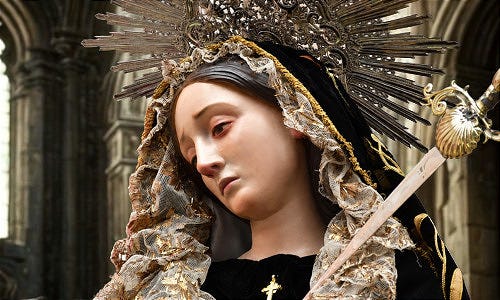
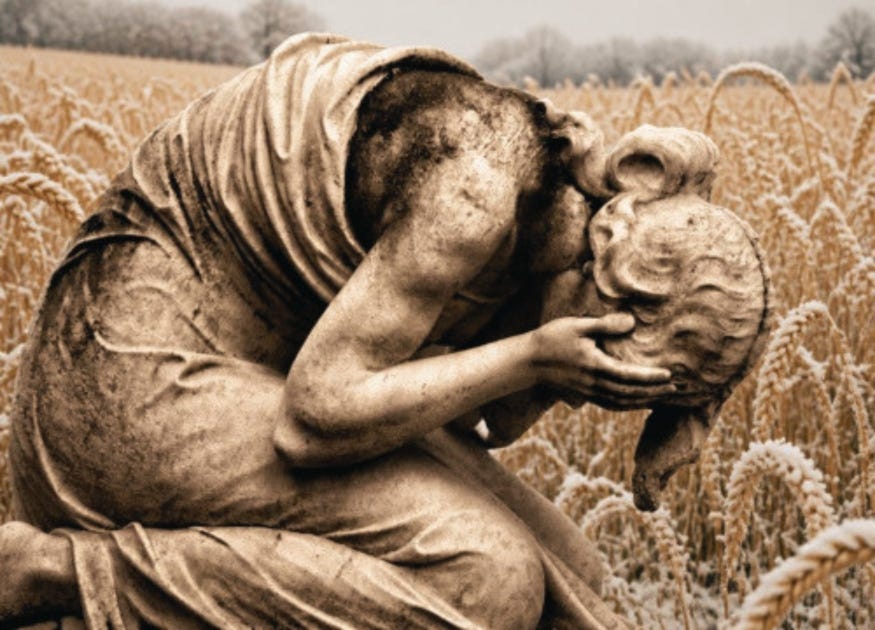
The light is lessening now as the earth tips gracefully into the dark seasons of the year. Here in the crisp, golden edge days of September, the natural world begins its slow, instinctual surrender. We see it in the fading of the green, the quiet retreat of animals, and the dropping of seeds into the underworld. A cosmic weeping of sorts.
It is no coincidence that this seasonal descent, marked by the autumn equinox, mirrors a profound liturgical reality. As the ancient world watched Demeter weep for her daughter Persephone’s descent into the underworld, the Church designated this month as a time to remember the Seven Sorrows of Mary whose son made a similar but truer more powerful descent.
Across time, the human heart has always known that September is the month of the suffering mothers. It is a sacred threshold where the material world and the mystical world meet to teach us about grief, loss, surrender, suffering and waiting. We are tempted, always, to try and avoid suffering by escaping into the purity of a pristine spirituality that views the physical, and the material, even our bodies as a prison and the cause of all our sufferings. But the archetype of the suffering mother, brought to its perfect, luminous completion in Mother Mary standing unyielding by her betrayed and tortured Son shows us a radically different path. The path of Mother Mary shows us that sorrow is not a dead end or an evil to be fled, but a raw, holy material. When we refuse to turn away from the agony of this world, and instead choose to unite our human will and our sufferings to the divine, a quiet spiritual alchemy occurs: our deepest, most shattering wounds are slowly, mysteriously transmuted into a glory we can scarcely comprehend.
The Suffering Mother is not merely a metaphor but a universal lens through which humanity processes loss, transition, and grief. Through both the myth of Demeter and the Sorrows of Mary, we discover that suffering in the physical world is not to be shunned, but an offer of a real possibility that suffering can be transformed through surrender and love.
I have written in many places that I consider the myth of Demeter and Persephone to be foundational, a cornerstone of ancient Western civilization. In an even more ancient understanding it is the Earth’s first grief witnessed yearly by our remotest ancestors.
In my previous endeavors I worked with the facets of the myth that revolve around the complex, agonizing, and beautiful evolution of the mother-daughter relationship, individuation, and the inevitable coming-of-age. I found this myth to be one of the most fertile places in the Western canon where women could find a mirror capable of bringing into focus the experiences of women without reference to wars, technology, politics, or the conquering aspirations of kings, generals and armies taking center stage. Hades and his backroom dealings with his brother Zeus plays a role of course, but the central action and the transformation it explores belongs to women.
However this myth is a very ancient one and in its most primitive form it is a story of the changing seasons and Persephone is a personification of vegetation. Persephone is herself, and also her mother Demeter, Mother Earth. As the equinox arrives she dies back into the earth and even as she rests in the underworld of the soil she suffers and weeps as she endeavors to survive the cruelty of the winter season. The male counterpart to this story is the much later John Barleycorn from an English/Scottish ballad that dates to Elizabethian times and in oral tradition to a time before that. Both Persephone and John Barleycorn are pulled into the earth at the dying of the year, with Persephone abducted and John cut down in a cruel and viscious way. The natural world grieves, and we observe a kind of cosmic weeping of all things.
The story of Persephone remains a staple of the archetypal imagination and finds its way into books music and films. Fairly recently a regency romance called Seeking Persephone, based on the book by Sarah M. Eden made its way to the screen. (Altert, spoilers ahead.) In the film we encounter a failure of presence by Adam’s (Hades) mother. She illustrates the tragic archetype of the mother who cannot bear the weight of her child’s agony and instead chooses to turn away, unable to stand by her son during his suffering. Her son now bears the sting of rejection and the trauma and turmoile of emotional abandonment. He is unable to trust and becomes detached, aloof and even hostile in his pain.
We can contrast this with Mary’s Sorrowful Way which embodies the capacity to stand by suffering. Mary does not flee, shield her eyes, or disown the trauma; she stands resolutely by her son through the entirety of his multi-layered sufferings.
Mary, though not a divine entity herself, walks alongside this divine sacrifice. She bridges the gap for us: a human being experiencing the ultimate suffering, yet choosing through an intention of her will to unite her grief to the divine plan. It is interesting to note that Adam’s mother in Seeking Persephone is tragically aware of her flaws and deeply regrets that she was unable to be with her son through his sufferings. This admission towards the end of the movie heals her as she recievs her son’s forgiveness and Adam also find the healing he needs allowing him to dare to trust and love Persephone. There is something very human, hopeful and healing in this exchange. Suffering was hard for these characters, fumbled and handled poorly, but ultimately the hurts were mended and that opened the way for redemption and love to flood in.
The mechanics of how we come into suffering follows two distinct paths. As both Demeter and Mary suffer and mourn for their children we can look at what happens to each and discern the ways that suffering arrives and how it can be experienced.
Persephone is snatched away. Her mythic descent begins with violence and a lack of agency. We can contrast that with the higher principle of self-emptying (kenosis) and the fully voluntary, self-giving passion of Jesus Christ.
Sometimes suffering crashes down upon us, and sometimes we offer ourselves. Tragedy strikes and somehow we must make sense of our suffering. If you have children you know that at some point in their lives you will suffer on their behalf or because of them. We step into that suffering for love’s sake. That is true for many kinds of relationships. Suffering born of love is bittersweet and is almost never encouraged or admired in today’s narccistic climate.
Carl Jung saw the images, symbols and processes of alchemy as a fitting symbolic system that illuminated the growth of the inner life of the soul over the course of a lifetime. Suffering is held within the alchemical framework, especially in the stage called Nigredo, or blackening, represented darkness, breakdown, grief, depression, confrontation with the shadow and certainly suffering. What comes out of suffering or Nigredo is seen in the next alchemical stage the Albedo, or whitening, which brings clarification, purification, and the emergence of conscious insight. Passing through a time of sorrow ,whether we are abducted into the suffering like Perserphone and left to grieve like her mother or if in imitation of Christ we voluntarily take on a time of suffering, or sacrifice out of love for another when the time is through we undoubtably will have far greater and deeper insights into ourselves, and likely will have grown out of petty selfishness, or indolent attitudes that demand personal comfort to the exclusion of any exertion over an addiction to ease in favor of doig a hard thing for love of another.
The willing union of human suffering with divine love operates like a spiritual alchemy that changes base, destructive earthly pain into eternal glory, actively expanding and refining the human soul.
If we are to learn from September’s Sorrowing Mothers ae must confront the modern urge toward spiritual bypassing. This impulse is rooted in the dualistic desire to label the physical world, the physical body, and material suffering as inherently bad or evil along with an attempt to escape any suffering and view the state of “no suffering” as a superior spiritual achievement.
We can counter spiritual bypassing with the classical paradigm of accepting and persevering through the reality of sorrowing, harboring an open hope that a greater, unfathomable eternal good for our soul is being birthed out of current sufferings.
Nature’s recurring pattern of dying and rising serves as our constant instructor that loss is never the final word in this physical, created world.
Whether as parents, spouses, siblings, or friends, we will all witness crisis, sickness, and the loss of those we love. Suffering is part of our world and our human experience. It is not punishment or even evil, though the particualr type of sorrrow or suffering may indeed be experienced as such. The great, uplifting sacred hope is that however devestating the suffering it can be a means of unimaginable transformation for the good of the soul.
We can find solace in the sufferings of Persephone and Demeter and what their myth teaches and even more powerfully we can find consolation in Mary as the Mother of All Sorrows and her son as the Man of Sorrows, acquainted with grief. Their lives assure us that within the grand divine architecture, sorrow has a designated place, it is not as a dead end, but a gateway to a beauty so profound it surpasses human comprehension.
Each month is a gift, each season of life filled with goodness beyond measure.
Thank you for reading Hedge Mystic and for being part of this vibrant, growing community of creative, spiritual humans. You are always welcome here, appreciated, and loved.
Are you moved by this piece and want the Hedge Mystic Community to benefit and grow? Then, make a one-time donation. Click the Donate button below!
or

Hedge Mystic is a reader-supported publication based on a value-for-value premise. If you find value in Hedge Mystic, support my work and consider becoming a paid subscriber. Your involvement and financial support are deeply appreciated. Thank you.
Divine timing!! Thank you.
Stabat Mater